Carl Sagan once said: imagination will often carry us to worlds that never were but without it, we go nowhere. Long before space exploration was considered a reality, artists have been creating countless pieces depicting the version of outer space they fashioned in their own mind. These artistic masterpieces served as inspiration to space explorers in the 20th century, and continue to inspire young minds til this day.
Buzz Aldrin on the surface of the moon
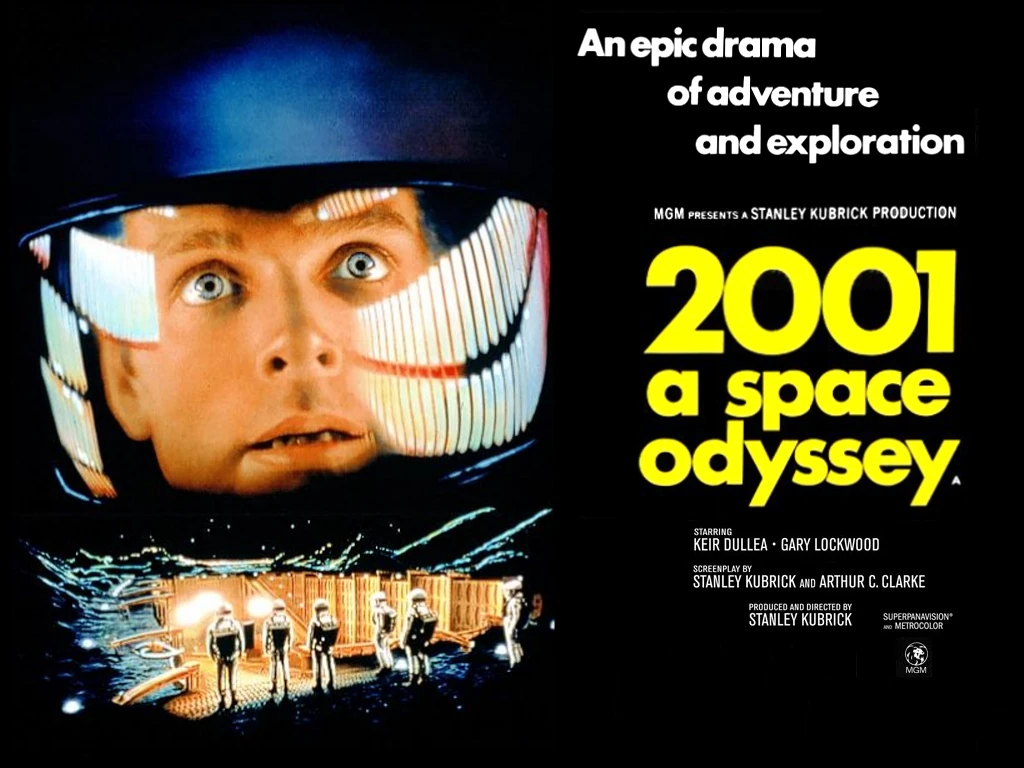
Space is a culmination of all the topics we have covered so far in this course, and similarly, owes much of its success to art. The lack of knowledge in this field allows artists to craft their work without the restraint of reality. From 2001: A Space Odyssey to the Martian, film makers have been exploring the idea of life in space for decades. Not only did these pieces inspired many to pursue a career in space exploration, they also provided a surprisingly realistic look at life in space in the future. Some may even say that they directly influenced the development in space exploration technologies.
Poster for 2001: A Space Odyssey
Take 2001: A Space Odyssey as an example, it is important to note the similarity between the space stations on film and in reality, flat-screen computer monitors and in-flight entertainment on film that were only invented after the movie was aired. These films not only brought space exploration into the spotlight but also provided inspiration for inventions crucial to the program.
At the same time, the imagination of artists also illustrates the downsides regarding this field. While many have devoted their lives to connecting with unknown civilizations, fictional work depicting hostile aliens serve as note-worthy cautionary tales.
Daleks on Doctor Who
On the other hand, the advancement in space technologies allowed for a new field of artistic expression, 'Space Art'. Artists such as Chesley Bonestell work with scientists to create fascinating depiction of the universe aimed to publicize space exploration to the public. These pieces introduce the wonders of the universe and space exploration technologies. At times, spacecrafts are not only the subject of the artwork but also their carrier. Paintings, sculptures, and many more have flown in them and might even be left on the moon!
Exploring Mars by Chesley Bonestell(1953)
As proven time and time again throughout this course, art and science are inseparable. Their subtle yet undeniable connection allow both fields to flourish under the influence of one another and I look forward to seeing what the future holds for them.
Citations:
2001, a Space Odyssey. Dir. Stanley Kubrick. Prod. Stanley Kubrick. By Stanley Kubrick, Arthur C. Clarke, Geoffrey Unsworth, and Ray Lovejoy. Perf. Keir Dullea, Gary Lockwood, and William Sylvester. Metro-Goldwyn-Mayer, 1968.
"45th Anniversary of Apollo 11's First Human Landing on the Moon." Arabian Business. N.p., 21 July 2014. Web. 08 May 2016.
"Dalek." Tardis Wikia. N.p., n.d. Web. 08 May 2016.
"N.A.S.A. Space Shuttle Columbia Mission STS-61-C January 12, 1986 G-481." Vertical Horizons. Vertical Horizons, n.d. Web. 08 May 2016.
"The 1st Art Exhibition in Earth Orbit on EUROMIR 95." Ars Ad Astra - The 1st Art Exhibition in Earth Orbit. OURS Foundation, n.d. Web. 08 May 2016.
Vergano, Dan. "Who Was Carl Sagan?" National Geographic. National Geographic Society, 17 Mar. 2014. Web. 08 May 2016.
Woods, Athur. "Cosmic Dancer - a Space Art Intervention by Arthur Woods." The Cosmic Dancer Project : Art In Space : Arthur Woods. Arthur Woods, n.d. Web. 08 May 2016.
On May 7th, I attended the AIX Scent Fair at the Hammer Museum. Co-presented by The institute of Art and Olfaction and Luckyscent/Scent Bar, the three-day scent fair contains a myriad of events and activities, such as a Kickoff Keynote & Panel, Workshops, Award Show, and more. During our visit, none of these events are on-going and we only visited the 43 showcases on the third floor of the museum.
Since this is a fair regarding the art of fragrances, it was quite an different experience than other art fairs I have attended. The fragrance makers are all kind enough to share with us the inspiration behind their work, and it is fascinating to see how they chose different scents to portray their ideas. The way they select the components of the fragrances are not just based on how they can complement each other to produce a pleasant aroma but also how well they fit into the story they want to tell through the fragrance.
Douglas Bender and I
Another aspect I found interesting regarding the exhibits are how they are decorated so deliberately to help with the story telling. From the table stands to the tester design, it is easy to tell how much effort was put into the planning process.While some opt to let visitors test the fragrance out of the bottle, others chose to put the fragrance on other objects. The showcase that I found the most remarkable is the one by Douglas Bender from Charenton Macerations. The three fragrance he brought to the showcase are 'Asphalt Rainbow', 'Christopher Street', and 'Eye, Hatshepsut' as part of his Nothing2See piece. As he was telling the story of each fragrance, visitors are shown the contents of a box and smell the fragrance in it. The boxes are great visual aids that helped us understand the meaning of the fragrance.
Although the fragrances showcased in the fair are not the most aromatic, the stories behind them make them the most remarkable ones around. I highly recommend this exhibition to anyone interested in an atypical way of storytelling (who is not sensitive or allergic to fragrance and perfumes).
A tip for those who plan on attending the fair: the fragrance can cause headaches after a while, it helps to bring and smell a can of coffee bean in-between trials to neutralize the fragrance and lessen the headache.
Throughout this quarter, we have been encouraged to explore the relationship between art and science. In fact, the subject of this week's discussion is the perfect example of their symbiotic relationship.
Due to the nature of nanotechnology, the field was merely conceptual until a major breakthrough in early 1980s when Scanning Tunneling Microscope (STM) was invented, allowing for the imaging and manipulation of particles at the atomic level. Since then, nanotechnology has been applied in countless consumer and military products, and is commonly regarded as the key to the future technological advancements. I believe that if the technology is applied properly, not only will it provide a new way to create art, it can also revolutionize the field of art conservation.
Zinc Oxide Nanorod Landscapes by Kajene Murugathasan and Xufan Li
Funded by the European Union, the Research Center for Colloids and Surface Science in Italy had been experimenting withproducts that can clean and conserve artwork in a safer manner. Four classes of preservation and cleaning products are created for different materials using nanotechnology: Nano-particle dispersions for plaster, marble and other carbonate materials; Alkaline nano-particle dispersions for pape, parchment and leather; Oil-in-water micro-emulsion as coating removal; and Thin gel for cleaning oil paintings. These methods are already being used at museums and poised to be commercialized in the near future.
Fresco from the S.Cristoforo Church in Milan
(Before and After cleaning with microemulsion)
Aside from art restoration, nanotechnology are often used as a tool by artists in their work. Through the use of STM, scientists and artists are able to produce illustrations and images during their research that turned out to be quite beautiful. Researchers from IBM even produced a minute-long animated film using these images.
'Rose Petal' by Parize Romain
On the other hand, art can also be the key to understanding scientific concepts. In the exhibitions created by Professor Victoria Vesna and Professor James Gimzewski, the audience are able to experience nanotechnology first-hand. The nature of nanotechnology makes it very difficult for the general public to understand without first having a scientific background. This project offered visitors the chance to manipulate carbon molecules using their shadows, all while viewing the changes in atomic behavior.
The symbiotic relationship between science and art is irrefutable. Nanotechnology without art would be nearly impossible for everyone to grasp while without nanotechnology, we could soon lose some of history's most remarkable pieces and new illustrations at a nano-scale would never see the light of day.
Kapoor, Aarti. "NanoScienceWorld." NanoArt: When Science And Technology Meet Art by Aarti Kapoor. NanoScienceWorld, 2 May 2010. Web. 06 May 2016.
Lovgren, Stefan. "Can Art Make Nanotechnology Easier to Understand?" National Geographic. National Geographic Society, 23 Dec. 2003. Web. 06 May 2016.
MediaArtTube. "Victoria Vesna and James Gimzewski - Zero@wavefunction, Responsive Environment/ Nano Art, 2001." YouTube. YouTube, 21 Sept. 2009. Web. 06 May 2016.
Murugathasan, Kajene, and Xufan Li. "Pan Group." Pan Group. University of Georgia, n.d. Web. 06 May 2016.
Newsroom Editior. "The Fine Art of Nanotech - Horizon 2020 - European Commission." Horizon 2020 - The EU Framework Programme for Research and Innovation. European Compission, 23 June 2015. Web. 06 May 2016.
On May 3rd, I attended a lecture hosted by Anne Niemetz, a media artist and UCLA alumni. During the hour-long lecture, Niemetz briefly introduced her work in interactive installation and wearable technology as well as the work by her students in World of Wearable Art, a leading international design competition.
Dancer Performing Standing Waves
The lecture started off with a short yet engaging introduction to her work in installation and stage, namely REVOLVE, Standing Waves, and The Dark Side of the Cell, giving the audience a insightful look into the artist's process. Throughout her presentation, she repeatedly stressed the importance of science in her work. I am particularly impressed by the presentation she gave regarding Standing Waves, a piece integrating the study of sound and sleep patterns into dance choreography. She showed a thorough understanding of beats as well as the human physiological cycle. Through the use of different frequencies, she was able to demonstrate the concept of beats in a simple yet comprehensive manner. This is rather surprising since it never occurred to me that artwork can be such a useful tool in introducing scientific concepts! I remember learning about the same concept in a physics lecture and although the professor tried using demonstrations to make it as interesting as possible, Niemetz did a much better job at explaining the basics in a more straightforward manner.
'Ura ra' by Rachel Hockin
She then moved on to introducing some of her students' best works in World of Wearable Art. WOW is described as a annual gathering of the most innovative minds in the field of wearable art, and needless to say, the work presented are stunning and beyond impressive. The way technology is integrated into the designs are spectacular and is the perfect example of how technology and art can join forces to create something both beautiful and functional. Out of all the garments presented, Rachel Hockin's work 'Ura ra' is the most memorable piece. This piece is inspiring not only because of the level of through behind each and every piece of this elaborate costume but also the way technology is incorporated to take it to the next level.
Compared to the first art|sci event I attended, I enjoyed this event a lot more and would recommend it to anyone interested in design. All the pieces presented are truly fascinating and I am grateful for the chance to be introduced to such wonderful pieces of art.
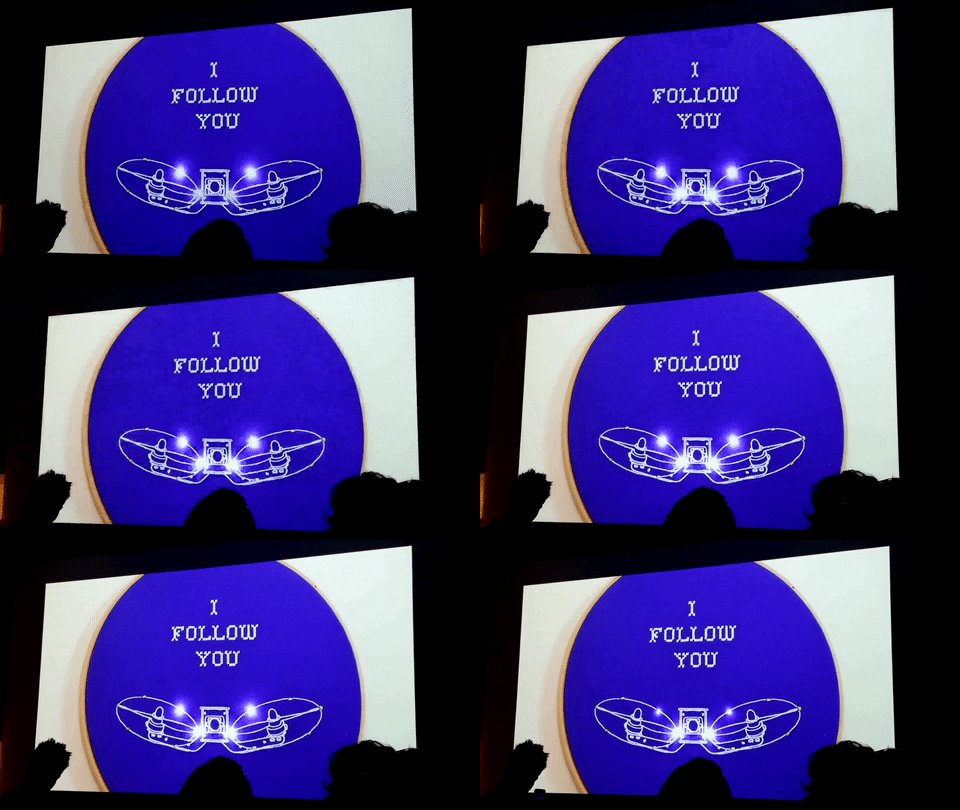
On April 19th, I attended an Art|Sci DMA lecture by Toni Dove, a New York-based artist and pioneer in the field of interactive cinema. During the lecture, Dove started off by describing her work with interactive narrative since the 90s, and how she experiments with experimental theater as well as film-making. She went on to introduce some of her more noted pieces, such as 'Spectropia: A Ghost Story on the Infinite Deferral of Desire', and 'Lucid Possession'. They are all created from a feminist standpoint with hints of science fiction and unlike any other art pieces I have seen before because the performance incorporate both pre-made films as well as movement of the artist at that moment. Dove demonstrated how she manipulates the films during her performance using a computer interface. I found it particularly fascinating to see how her hand gestures are able to control the speed and presentation of the movies. This is a perfect example of how art and science can collaborate to create a new art form, one dubbed as "cyber-theater" by Dove based on its interactive nature. A computer program is responsible for translating the artist's motions into instructions that can control the film.
A sketch of one of her pieces
Although the work she presented are quite intriguing and unusual, I found it strange that she was unable to present a reasonable answer when asked about the purpose and motivation behind her work. To me, art is not only a way for people to express their emotion but more often, one to portray an idea and present it to the public. Throughout her lecture, Dove never addressed the reason behind creating such pieces and even when prompted, failed to explain in a way that I and several others could understand. While I acknowledge that one does not need to have a reason to create art, I am very curious about the means she used to obtain the sponsorship for the creation of these pieces when so many research projects developed for the betterment of the society are forced to shut down every year due to lack of funds.
That being said, I highly recommend Dove's lectures and performances. It is wonderful to see how the collaboration between art and science has give birth to a myriad of art forms that would otherwise never have existed and I look forward to attending more similar lectures.